Saturday, August 31, 2019

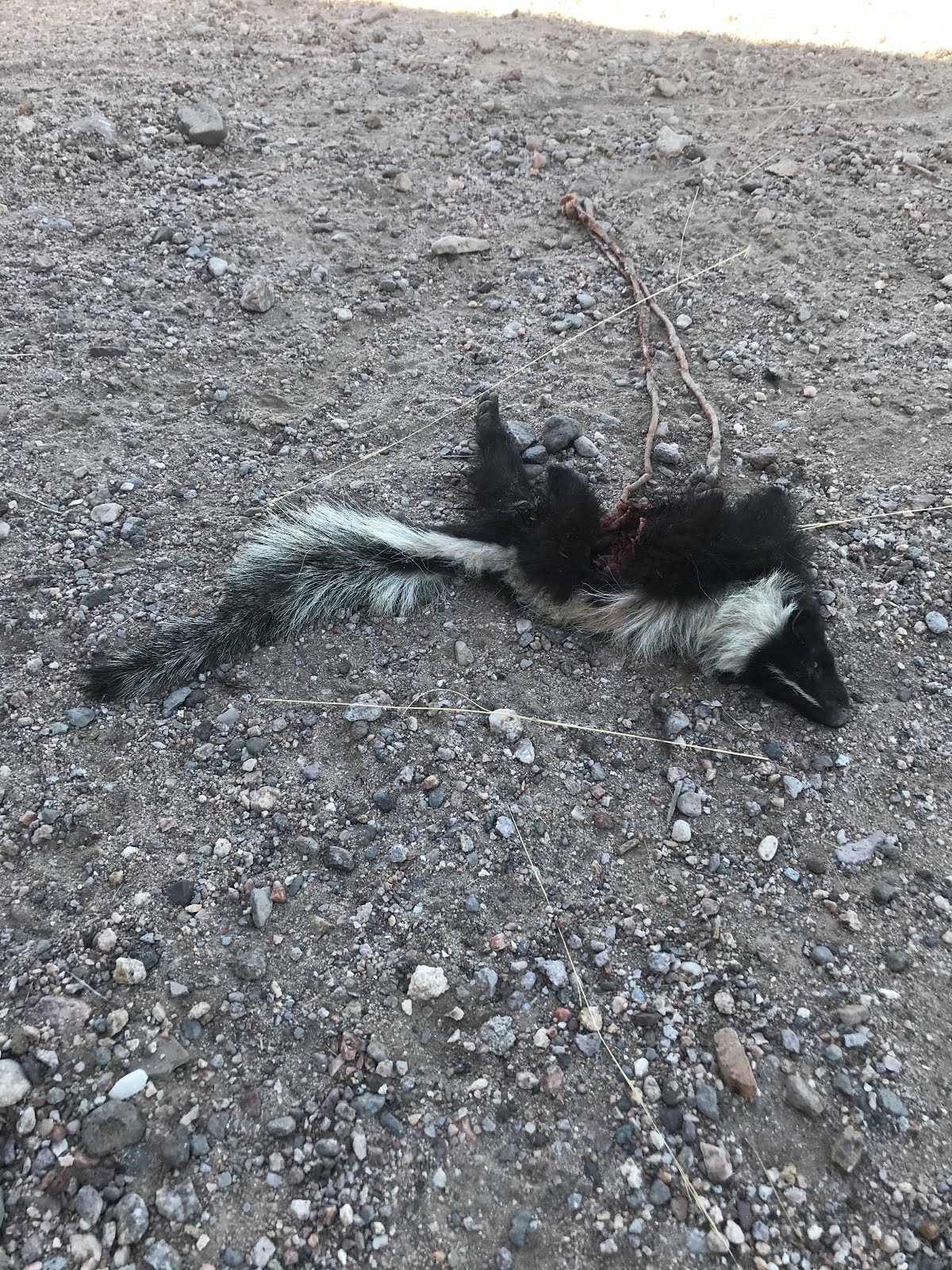
When you wake up to an awful smell!

The ranch dogs brought me yet another gift this morning. So far they've brought me a badger, porcupine, bobcat, and now a skunk!


Needless to say, the pups are not on my nice list!!! They however don't smell, so I'm not sure if they found him alive or dead already. It's been very dry this summer, we haven't had any significant rain at the ranch for several months. We have had some good rain a few miles away, so the wild life has been migrating in that direction so we're seeing a few visitors. Now if I can keep the ranch dogs from eating those visitors! 🤦‍♂️

And into the forest I go, to lose my mind and find my soul

Thursday, August 22, 2019

Always looking for a good camp meal!


Camp Skillet Recipe

This Camp Skillet Recipe is one of our favorites when we go camping. It is simple to make with just a few easy ingredients with little cleanup which is a bonus when you are out in the bush.

This recipe is easy to modify with whatever veggies you prefer. You can easily add in some peas, broccoli, beets, parsnips or whatever you happen to have on hand in your cooler.

I am a huge fan of dehydrating fresh greens. Every year we grow a large garden full of swiss chard, spinach, kale… and you can’t forget about our fabulous Moringa Trees. Each spring I dry enough super greens to last us throughout the year. We like to sprinkle them on almost every meal we make – from pizza to salads. It is a perfect way to add some extra nutrition to your meals when you are out camping.

For the complete recipe, checkout Bold Canyon Outdoors

Timeline-Old Roads.doc


I was doing some research about the area where I grew up, and came across this little tidbit of information. I've been posting a little more history lately, I guess that happens when you reach middle age.

Timeline – San Jacinto plains
The Spanish Period

Captain Juan Bautista de Anza and a party of thirty-fourexplored this area to find a overland route to Alta California from Sonora in order to supply Missions from the presidio of Tubac. All prior shipments were by sea and very expensive for Spain. Anza and Mystic Lake –San Jacinto Lake were traversed) Thursday, March17 & 18, 1774 (Old Roads, page 6&7)

June 1798, Mission San Luis Rey de Francia was foundedand was the 18th mission in the chain.

San Jacinto Rancho: Likely founded August 16, 1819 (Old Roads – page 17). The largest Rancho in Riverside County (130,000 acres), South to Temecula, north to the Badlands, east to the present-day city of San Jacinto and westward to the Woodcrest area. A grazing Rancho (Under Supervision of the mission San Luis Rey)

Missions were to settle the land, convert the Indians to Christianity so they could become Spanish citizens and hold the area for Spain. Land used by the Missions became Mission property.

Casa Loma Hill a outpost compound consisting of a small rooming house, several granaries and a small Chapel located by present day Ramona Expressway and Warren Road. (Top of page 18 and page 44 Mexican grant to Estudillo)

Corral de Pilares (Basin Corral) or “basin corral” was an adobe structure and four acre pens surrounded by an adobe wall and it was used for branding cattle. The location of this site was on the west side of the San Jacinto River and the east of the Bernasconi Hills. In 1853 this site had fallen to disrepair. (Old Roads - Page18)

The Mexican Period

1810-1821: The turmoil ended with the Convention of Cordova. New Spain became part of the land of Mexico.

1824: The Colonization Act and the Regamento of 1828 both of which liberalized land policy and made concessions to prospective settlers.

August 1833: Mexican government passed the Secularization Act taking effect in 1834, which closed Missions and relinquishing the mission’s vast tracts of land over to the California governor for dispersal as he saw fit.

January 13, 1847 Capitulation (Surrender/Treaty) of Cahuenga was signed by the US military commandant ofCalifornia, Lieutenant Colonel John C. Fremont, and Andre’s Pico, Commander of Squadron and Chief of the National Forces of California.


1846-1848 The end of Mexican rule.
MC 4:4-439
San Jacinto Nuevo y Portero
Thomas W.
Sutherland, guardian, etc.
48,861.10
1/9/1883
The Treaty of Guadalupe Hidalgo was the end of fighting between the US and Mexico.


Early American Period

September 1850, the state of California was formed and admitted to the United States without having spent time as a territory.

Wednesday, August 21, 2019

Doing a little genealogy research, and found this....


Major General Joseph Bartholomew 1766-1840


(March 15, 1766 – November 3, 1840) was a general in the Indiana Militia and served in numerous military conflicts. He also worked as a farmer, hunter, trapper, self-taught surveyor, and politician. Bartholomew County, Indiana and the Bartholomew Trail were named after him.[1]

Though he was only 10 years old at the outbreak of the American Revolutionary War, he joined the local militia and helped defend against Native American tribes who were raiding the western frontier.[4]
After moving to Kentucky in 1788, Bartholomew remained active in the local militia, and engaged in numerous skirmishes with Native Americans. During the Northwest Indian War (Little Turtle's War), Bartholomew served as a scout for General "Mad" Anthony Wayne and was present at the signing of the Treaty of Greenville.
After moving to Indiana, he received a commission as major in the Clark County militia on September 21, 1803. Three years later, he was promoted to lieutenant colonel. On November 7, 1811, he took part in the Battle of Tippecanoe. Recently promoted to colonel, he led 120 militia members under Governor William Henry Harrison.[6] During the battle, Bartholomew was shot and seriously wounded in his right arm.
For his leadership during the Battle of Tippecanoe, Bartholomew was promoted to brigadier general.[7] The Indiana territorial legislature passed a resolution on December 4, 1811, which read, "Resolved… that the thanks of this house be presented to Col. Luke Decker and Col. Joseph Bartholomew, the officers, non-commissioned officers and men composing the militia corps under their command…for the distinguished valor, heroism and bravery displayed by them in the brilliant battle fought with the Shawnee Prophet and his confederates on the morning of the 7th of Nov, 1811 by the Army under the command of His Excellency William Henry Harrison."[8]
When Bartholomew's son fell ill, he volunteered to enlist as a private in his place under the command of Colonel Russell of the 7th Regiment to fight in the White River Campaign during the War of 1812.[9] Colonel Russell praised Bartholomew, telling the Indiana territorial governor, "Col. Bartholomew acted as my aide-de-camp; the veteran has been so well tried in this kind of warfare, that any encomiums from me would be useless."[10] In 1816, he was commissioned as major general, the highest rank at that time. He served as major general of the Indiana militia until 1822.[11]

After his wartime military service came to an end, Bartholomew became involved in politics. In 1818, he served on the Indiana General Assembly, and was elected to the Indiana Senate in 1820.[12]He was selected to be a member of the commission that would choose the location of the capital of Indiana, and helped pick Indianapolis as the new site. He would often claim "to have dug the first dirt for the State capital."[13] Though he moved home in 1822, he continued to serve the state on the board of commissioners for land deeds. He retired in 1825.[14]

His grave marker was placed by the Grand Army of the Republic in 1894 with the inscription "To the memory of Maj. Gen. Joseph Bartholomew Hero of Tippecanoe. He fought in the Revolutionary War, The War of 1812, & the Black Hawk War."

Sunday, August 18, 2019

My response to news of Marty Sampson having 'Shaky Faith'


Something to think about

As Christians renounce their faith

“A farmer went out to sow his seed. 4 As he was scattering the seed, some fell along the path, and the birds came and ate it up. 5 Some fell on rocky places, where it did not have much soil. It sprang up quickly, because the soil was shallow. 6 But when the sun came up, the plants were scorched, and they withered because they had no root. 7 Other seed fell among thorns, which grew up and choked the plants. 8 Still other seed fell on good soil, where it produced a crop—a hundred,w sixty or thirty times what was sown.”x [1]

I am not all surprised to see some prominent people on social media claiming now that they are losing their faith. Nothing really surprises me on social media anymore. I wonder why that is? Anyways, I theorize that it comes down to the charismatic, Pentecostal nature of the modern church. Everyone in attendance at a ‘modern’ church today is looking for an experience, with multimedia displays, concert like worship, and flashy emotional pastors, it really is not a mystery.

I’m sure a few people out there believe like I do, that in the attempt to make church relevant to the modern person with the loud music, flashy design, social media outreach, that the meaning of church has been lost. The proof is in the headlines as pastors, writers, composers and a few others have been very vocal on their losing their faith.

Well, I’m here to point out the obvious; they didn’t have faith to begin with. At least they didn’t have a well-grounded faith that would stand the test of time and infliction.  There is a reason I started with Matthew 13:3, the parable of the sower. In that parable the sower is casting out seed, we see some hits the hard path, and is devoured by birds. Some is cast in shallow, rocky soil, sprouts fast but the sun burns it away. While other seed is cast in thorns and eventually chocked out. Only the seed cast on good soil takes root and flourishes. Many in the modern church fall into the second and third category.

Attendees in the modern church walk into a compelling and easy environment full of fun branding, coffee shops, and swag merchandise. They sit in comfortable seats, listening to loud catchy rock like music that repeat easy to learn phrases in snappy tunes. The pastors then come out and give feel good messages about what ones life can look like while attending church. Not very often are the hard issues dealt with; and when they are they are based on faith and promises of an easier life later on.
Today’s churches are based on worship. It’s the main focus, with some churches dedicating almost half their time with it.

Now, I’m not arguing against worship time. It can reach people on an emotional level, and be very beneficial to the growth of a church. It’s a fact of life that a church is either growing or dying. I’ve attended a few churches that were obviously dying. They were going through the services, with all the above elements, with a dozen or less attendees. Not really saying anything, but begging for members to bringing new people in. I’ve also been in churches that had all the elements, with every seat filled, that still didn’t get the reason for church.

“All authority in heaven and on earth has been given to me.e 19 Therefore go and make disciples of all nations,f baptizing them in the name of the Father and of the Son and of the Holy Spirit,g 20 and teachingh them to obey everything I have commanded you. And surely I am with youi always, to the very end of the age.”j [2]

Why Church?


Jesus gave the commission of the church later in Matthew 28:18-20 to go out and make disciples, baptize them in the trinity, and teach them to obey everything he had commanded. Later on the church took on the roll of community center, taking care of those in a community that could not help themselves, and holding it’s members accountable. While what the church turned into was a good idea, it eventually strayed away from its original commission. In fact the church in many cases became a corporation. An entity that was more concerned with membership, bottom lines, and branding; than the finding of disciples, baptisms, and teaching.

Can the church still be relevant in our lives? Simply, yes. The church is still very important, while the corporate side of large church buildings is doing what it must to survive, the heart and soul of church is in homes, small groups, and peer to peer instruction. God is still relevant; his commission still stands “…surely I am with you always, to the very end of the age.”


What now?


How do we hold the leaders of our churches accountable? We need to simply talk with them, remind them what the purpose of the church is, volunteer, hold small groups, and just live lives that display the core beliefs of Christ’s commission. A person should never have to tell anyone they are a Christian, it should be obvious! Faith is never lost if it falls on good soil, is tended too, and cultivated properly. We can all rest on that truth.

I’m sure in the years to come, we will see a lot more people make public statements that they lost their faith, left the church, and turned to alternative concepts, those are people who simply were not serious about their ideas, they followed feelings, were blinded by cool swag, trendy songs, and fresh aesthetics. Church is much simpler, but a lot more profound than anything a modern worship church can offer. At least that’s my thought.


w Ge 26:12
x See Mt 11:15
[1] The New International Version. (2011). (Mt 13:3–9). Grand Rapids, MI: Zondervan.
e Da 7:13, 14; Lk 10:22; Jn 3:35; See 13:13; 17:2; 1 Co 15:27; Eph 1:20–22; Php 2:9, 10
f Isa 49:6; Mk 16:15, 16; Lk 24:47; Ac 1:8; 14:21
g Ac 1:8; 2:38; 8:16; Ro 6:3, 4; Gal 3:27; Col 2:12
h Jn 14:26; Ac 2:42
i Dt 31:6; 1 Ki 8:57; Hag 1:13; Mt 18:20; Ac 18:10
j Mt 13:39; 24:3
[2] The New International Version. (2011). (Mt 28:18–20). Grand Rapids, MI: Zondervan.

Life update.